
Carroll County Court Records After Arrest
The court pathway after a Carroll County jail arrest runs through the Circuit Court of Carroll County, the Circuit Clerk, and the Carroll County State's Attorney. The jail handles booking and local custody. The prosecutor decides what charges to file in court. The Circuit Clerk maintains the court file after the case opens. That file is the source for docket entries, hearing dates, filed charges, court orders, dispositions, and public case status.
The Carroll County Circuit Clerk page names Patty Hiher as Clerk of the Circuit Court and links to Judici court-record tools. The State's Attorney page names Michael T. O'Brien as State's Attorney and describes the office as the chief law-enforcement officer for criminal prosecutions in Carroll County. For current custody and booking details, use Carroll County jail inmate records. For booking photos, use Carroll County jail mugshots, since court records are not a mugshot gallery.
Find Carroll County Court Records After Arrest
Carroll County uses Judici as the public case-search path linked by the Circuit Clerk. During research, the direct Judici page displayed a human-verification gate, so full search fields were not visible. The important point is that Judici is the court-record route, not the jail-custody route. It is useful after the prosecutor or court has opened a case. If the arrest is too new, the case may not appear yet.
- Confirm the local arrest or current custody through the jail phone or sheriff records route when needed.
- Open the Judici Carroll County case-search path.
- Pass any human-verification gate and search by the available defendant name or case-number fields.
- Read the charge list, hearing entries, court orders, release terms, and disposition fields separately.
- Contact the Circuit Clerk when an older, sealed, expunged, or not-yet-indexed record is not visible online.
The Circuit Clerk screenshot shows the official county route to Judici links, court payments, clerk contact details, and office hours.
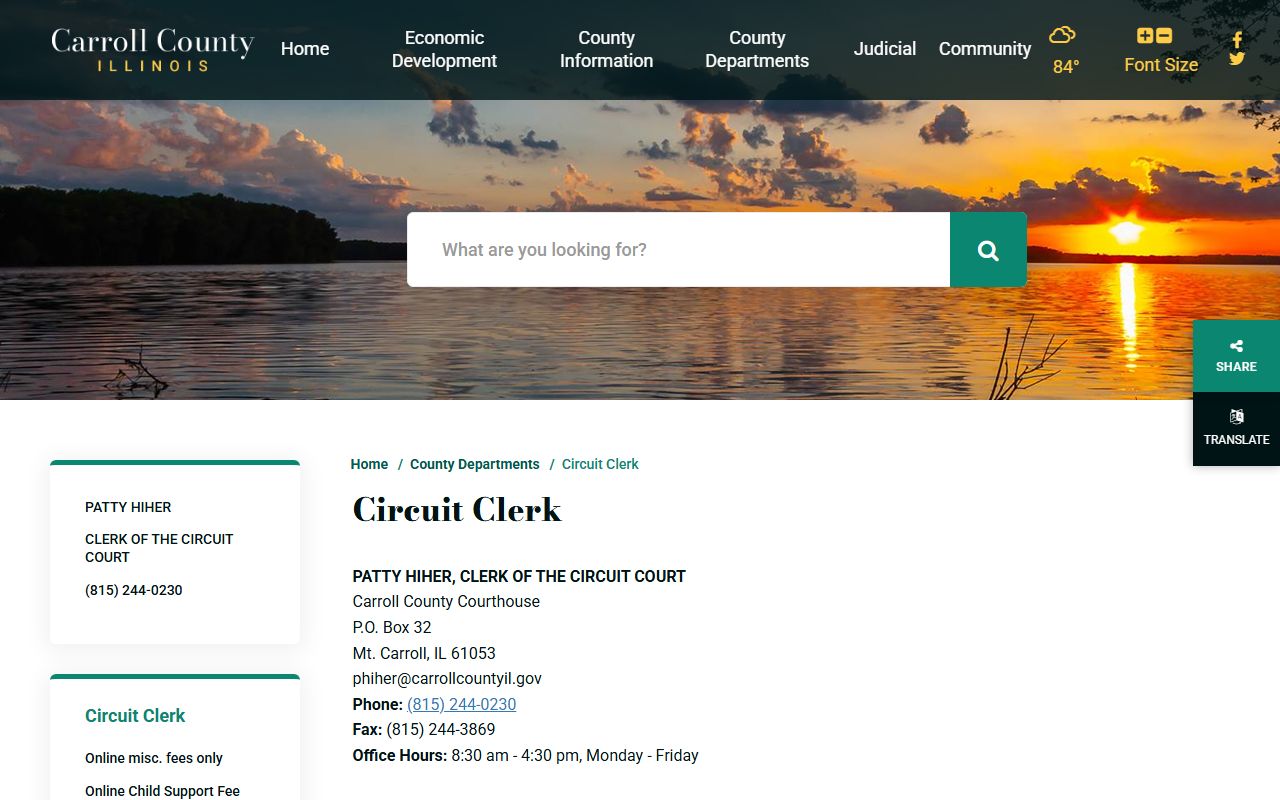
That office is the practical contact point when the public case-search system does not answer a court-record question after a jail arrest.
Carroll County Court Search Fields
The Judici inspection was limited by the public verification gate. Build the search expectation around what was actually visible and around the Circuit Clerk's official link, not around unverified fields. Judici also notes that it is operated by Judici.com and is not the court itself, so a court-certified record still comes from the clerk.
| Field Label | Type | Required | Options or Notes |
|---|---|---|---|
| Human verification | Gate | Yes to proceed | The inspected page showed "Please verify your humanity." |
| Case search | Web portal | Unknown | The Circuit Clerk links to Judici, but full fields were not visible due to the gate. |
| Login | Link | Optional | Judici top navigation showed login and account-related options. |
Charging Records After Arrest
Arrest charges and court charges are related, but they are not the same record. A law-enforcement agency may list arrest charges during booking. The State's Attorney then decides whether to file a complaint, information, indictment, amended charge, reduced charge, or dismissal in court. A person can be arrested on one theory, charged under a different count, or have charges changed as evidence and plea talks develop.
| Document | Who Uses It | What It Does |
|---|---|---|
| Complaint | Often initiated by law enforcement or the prosecutor | States the alleged offense and can start a criminal case. |
| Information | Prosecutor | Formally charges many offenses without a grand-jury indictment. |
| Indictment | Grand jury process | Charges an offense after grand-jury action in serious matters. |
For victim-witness or prosecution context, the Carroll County State's Attorney page lists the prosecutor's office and victim-witness coordinator. It is not a substitute for legal advice, and it is not the clerk's docket office.
Carroll County Charge Status
Charge status is the part of a court record after arrest that shows what is happening to each count. A pending charge is still active. An amended charge has been changed. A reduced charge is less serious than the original count. A dismissed charge is no longer being pursued in that case, although the full public-record effect depends on the case and any later sealing or expungement order.
| Status | What It Means |
|---|---|
| Pending | The charge is active and the case has not reached final disposition on that count. |
| Amended | The charge wording, statute, level, or count has been changed in the court file. |
| Reduced | The filed offense has been lowered or replaced with a less serious count. |
| Dismissed | The court record shows that the count was dismissed, but public access may remain until sealing or expungement. |
| Convicted | The court record reflects a guilty plea, finding, or verdict on that count. |
Pretrial Release After Arrest
Illinois changed pretrial release under the Pretrial Fairness Act. The Illinois Courts article on implementation states that Illinois became the first state to abolish cash bail on September 18, 2023. Current court records after a Carroll County jail arrest should therefore not be read through an old automatic cash-bond model. Many readers still say "bond," but the court decides release conditions or detention under the current statutory framework.
Under 725 ILCS 5/110-2, Illinois presumes eligibility for pretrial release and requires individualized conditions. Under 725 ILCS 5/110-6.1, pretrial detention requires a State petition and a hearing under statutory standards. A person may remain held because of a court detention order, a valid detainer, or custody in another system.
Release note: Jail staff cannot change a court release order. Use the court record for release terms and the jail phone for present custody.
Warrants Before Jail Arrest
No official Carroll County Sheriff active warrant search or warrant list was located on the county or sheriff website. A bench warrant tied to a Carroll County case may appear in court records or may require Circuit Clerk contact. An arrest warrant or civil-process issue may involve sheriff records. A search warrant is different because it authorizes a search rather than custody.
If a Carroll County arrest followed a warrant, the court record may show failure-to-appear history, warrant issuance, recall, bond or release conditions, and next hearing dates. The sheriff can answer some custody questions, but the jail does not clear a warrant. Use the court or issuing agency for warrant status and required appearance steps.
Charges Convictions Sealed Expunged
A court record after a jail arrest can contain accusations that never become convictions. It can also contain records that later become sealed or expunged. These differences matter when reading a Carroll County case file, because a filed charge is not proof that the person was convicted, and a dismissal does not always remove every public trace without a separate court process.
| Record Type | Meaning | Public Access Point |
|---|---|---|
| Charge | An accusation filed in court by the State. | Judici or Circuit Clerk, unless restricted. |
| Conviction | A guilty plea, finding, or verdict entered by the court. | Court record and criminal-history records, subject to law. |
| Sealed | Public access is limited, but some agencies may retain access. | Access depends on the sealing order and Illinois law. |
| Expunged | Qualifying records are removed from ordinary public view or treated as erased by court order. | Use the court order and official forms for updates. |
Restricted Carroll County Court Records
Illinois FOIA, court-access rules, and criminal-record statutes all create limits. 5 ILCS 140/7 allows exemptions and redactions for certain law-enforcement, privacy, juvenile, safety, medical, and protected records. 20 ILCS 2630/5.2 governs expungement and sealing procedures. The Illinois Courts approved forms and the Office of the State Appellate Defender expungement unit are the better sources for clearing-record procedure than the jail.
Carroll County also has remote-court rules. The May 2026 Zoom guidelines say participants should join at least 10 minutes before the hearing, use their full case name, and follow courtroom decorum. Recording, screenshots, photographing, publishing, broadcasting, or copying courtroom proceedings is barred unless a court order allows it. Those rules affect access to hearings, not the same thing as access to a certified court file.